- Connect Us:
- +91-9414816181
- info@rajasthantaxirental.com

Best Trekking Places in Jaipur: Trails, Hidden Gems and Complete Guide

Ranthambore Safari Booking: A Complete Travel Guide from Jaipur
June 22, 2026
Bhangarh Fort Story: History, Timings, Jaipur Distance & Travel Guide
June 30, 2026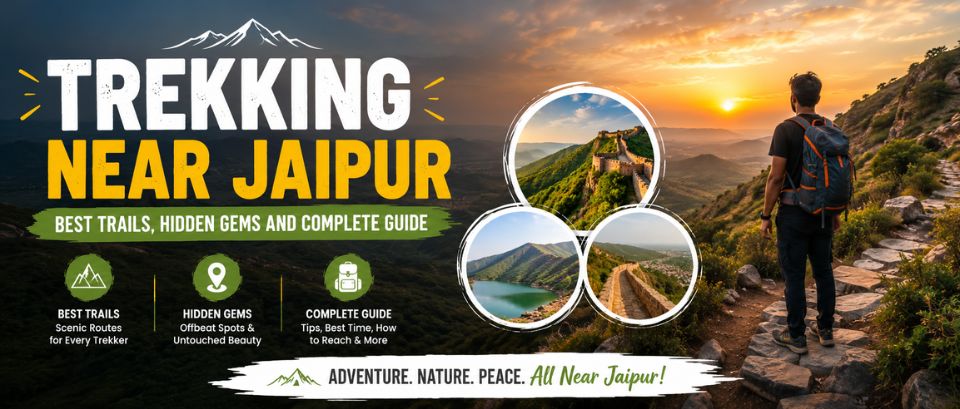
Explore Jaipur’s Best Trekking Destinations with Rajasthan Taxi Rental
Jaipur is famous not only for its magnificent forts and royal palaces but also for its scenic trekking trails that attract adventure lovers year-round. From the ancient paths leading to Nahargarh Fort to the peaceful hills around Amber and hidden trails near the Aravalli Range, Jaipur offers numerous trekking experiences for beginners and experienced hikers alike.
At Rajasthan Taxi Rental we make your trekking adventure more convenient by providing reliable taxi services to all popular trekking locations in and around Jaipur. Whether you’re planning an early morning hike, a weekend adventure with friends, or a photography expedition, our comfortable taxis ensure you reach your destination safely and on time.
Trekking near Jaipur has grown quietly into one of the most rewarding outdoor activities in Rajasthan. You do not need to travel to the Himalayas or fly to the northeast for a proper trekking experience. Within the city limits and just a short drive from Jaipur, there are trails to suit every level, from complete beginners taking their first steps to experienced hikers seeking challenging climbs through dense forests and rocky ridgelines. This guide covers everything you need to plan your perfect trekking trip.
Why Jaipur is a Trekker’s Underrated Destination
The Aravalli range that wraps around Jaipur is geologically ancient, far older than the Himalayas, and its character is completely different from what most hikers expect in India. There are no snowfields or dramatic altitude gains. Instead, what you find are dry deciduous forests of Dhok trees, rocky terrain dotted with wildflowers during monsoon, ancient ruins half-swallowed by vegetation, and temple spires visible from hilltops that have been climbed by pilgrims for centuries before the city around them existed.
The best trekking places in Jaipur are also surprisingly accessible. Most trailheads are within 10 to 30 kilometers of the city center, making it possible to start a trek early in the morning and be back in Jaipur in time for lunch. There is no complicated permit system for most trails, no steep entry fees, and no need for specialized gear on beginner routes. A good pair of shoes, a bottle of water, and an early start are genuinely all you need for most of the trails on this list.
The variety on offer is also remarkable. You can trek through wildlife sanctuaries where leopards have been spotted. You can climb to forts that no tour bus reaches. You can find a waterfall that most Jaipur residents have never visited. And you can do all of this within a short distance of one of India’s most famous heritage cities. If you’re looking for comfortable transportation during your Rajasthan trip, our Car Rental Service in Jaipur offers affordable pricing, multiple vehicle options, and dependable customer support.
Best Trekking Places in Jaipur
1. Nahargarh Fort Trek
If you are doing your first trek in Jaipur, Nahargarh is where most people begin and for good reason. The trail starts either from Purani Basti near the old city or from the Garh Ganesh Temple on the foothills and climbs approximately 6 to 7 km along a cobbled path that has been walked by pilgrims and locals for generations. The path winds upward through scrub forest, offering increasingly impressive views of Jaipur as you gain height.
At the top sits the Nahargarh Fort, built in 1734 by Maharaja Sawai Jai Singh II. The fort itself is worth exploring with its interlinked residential suites, multiple temples, and the best panoramic viewpoint in the city. The view from the ramparts at sunrise or sunset, with the entire Pink City laid out below you, is genuinely one of the most beautiful sights in Rajasthan.
Distance: 6 to 7 km return
Difficulty: Easy to Moderate
Best Time: October to March, or early morning in summer
What to Carry: Water, sunscreen, comfortable shoes
2. Hathni Kund Trek
Hathni Kund is the most popular trekking place near Jaipur among serious trekkers and is sometimes called the Water Valley Trek. The trailhead is at Charan Mandir, on the road leading toward Nahargarh Fort, and the path takes you into the denser section of the Nahargarh Wildlife Sanctuary. Unlike the Nahargarh Fort trail, this one moves away from the city quickly and within thirty minutes you feel genuinely removed from urban life.
The trail passes through dense Aravalli forest with large Dhok trees creating a canopy overhead. Ancient ruins of small temples appear along the route, and during and after the monsoon season, a seasonal waterfall at the trail’s end rewards the effort entirely. The water collects in a natural rock basin, and the area around it transforms into one of the greenest spots in the entire Jaipur region during July and August. Birdwatchers will find this trail particularly rewarding as the sanctuary is home to a wide variety of resident and migratory species.
Distance: 8 to 10 km return
Difficulty: Moderate
Best Time: July to September for waterfall, October to February for comfortable weather
What to Carry: Water, snacks, trekking shoes with grip
3. Amer Fort to Jaigarh Fort Trek
This trail is unique in the best trekking places in Jaipur list because it gives you two UNESCO-recognized heritage sites at either end of a single walk. The trek starts at the base of the famous Amber Fort and follows an ancient path upward through the Aravalli Hills that connects Amber Fort to Jaigarh Fort above it. This is the same path that Rajput soldiers walked for centuries, and the route still has sections of the original stone pathway intact.
The ascent gives you spectacular views of Maota Lake below and the rolling Aravalli terrain ahead. At Jaigarh Fort, the highlights include the Jaivana Cannon, one of the largest wheeled cannons ever built, and the fort’s remarkably intact water harvesting system. The complete walk from base to base is around 3 to 4 km but feels more substantial because of the elevation change and the rugged path surface.
Distance: 3 to 4 km
Difficulty: Moderate
Best Time: October to March
What to Carry: Comfortable shoes, camera, water
4. Bhuteshwar Nath Mahadev Trek
For those who want to combine trekking near Jaipur with a genuinely spiritual experience away from tourist crowds, Bhuteshwar Nath Mahadev is the trail to choose. This is one of the oldest trekking routes in the Jaipur region. The trail begins near Amer, either from Mahadev Shiv Mandir or Jati Balaji Temple, and the entire ascent takes between 40 and 60 minutes at a comfortable pace.
The path runs through rough Aravalli terrain with dry shrub vegetation on either side and several ancient ruins visible along the route. The destination is a Shiva temple that is estimated to be 400 to 500 years old, revered by local communities and visited regularly by pilgrims. The forest around the temple is quieter than most other trekking destinations near Jaipur, making it an ideal choice for those who prefer solitude over company on a trail.
Distance: 4 to 5 km return
Difficulty: Easy to Moderate
Best Time: Early morning round the year except peak summer
What to Carry: Water, offerings for the temple if visiting for spiritual purposes
5. Galtaji Temple Trek
Galtaji, widely known as the Monkey Temple, is already a popular religious site near Jaipur. But most visitors arrive by road and miss the fact that there is a proper trekking place near Jaipur that approaches the temple complex from the hills above rather than the road below. The trail winds through the Aravalli foothills and provides views of the temple’s pink-tiled towers appearing gradually through the hillside as you descend toward it.
The temple complex itself is ancient and built around natural freshwater springs that feed a series of sacred kunds, or bathing pools. Hundreds of monkeys live within the complex and are considered sacred residents. The combination of forest trail, historical architecture, natural springs, and wildlife makes this one of the most well-rounded trekking experiences near Jaipur for first-time visitors.
Distance: 4 to 5 km
Difficulty: Easy
Best Time: October to March
What to Carry: Water, light clothing, respect for the religious site
6. Kuntalgarh Fort Trek
For trekkers who specifically seek out historical ruins and are willing to go off the well-worn path, Kuntalgarh Fort is one of the most rewarding and least-visited destinations in the entire Jaipur region. The fort was built in the 13th century by Kuntal Dev Ji, the ruler of Amber, and has been abandoned for centuries. The trail to reach it runs deep into the Aravalli forest above Amber, with no signs, no crowds, and no facilities of any kind.
The path is rugged and requires navigational confidence, but the reward at the top is extraordinary. The ruins of the fort walls still stand in sections, overgrown with vegetation but structurally impressive. From the hilltop, you get views of Amber Fort and Sagar Lake below on one side and open Aravalli forest stretching to the horizon on the other. This is the kind of trek that stays in your memory precisely because almost no one else has been there.
Distance: 6 to 8 km return
Difficulty: Moderate to Challenging
Best Time: October to February
What to Carry: Water, snacks, fully charged phone, go with an experienced local guide
7. Chulgiri Trek
Located along the border of the Jhalana Forest on the southern edge of Jaipur city, Chulgiri is a moderately challenging trail that ends at a Jain temple perched on a rocky hilltop. The approach through the Jhalana Forest edge gives the trail a wilder character than many other routes closer to the city center, with occasional wildlife sightings including birds of prey, peacocks, and sometimes nilgai near the forest border.
The hilltop at Chulgiri offers a 360-degree panoramic view that takes in the Aravalli ridgeline on one side and the southern spread of Jaipur city on the other. The Jain temple at the summit is beautifully maintained and provides a peaceful resting point before the descent. The trail is less crowded than Nahargarh and Hathni Kund, making it a good option for those who prefer quieter routes.
Distance: 5 to 6 km return
Difficulty: Moderate
Best Time: October to March
What to Carry: Water, snacks, light jacket for early morning starts in winter
8. Ban Ki Ghati Trek
Ban Ki Ghati is one of the most scenic and underappreciated trekking places near Jaipur for nature lovers. The trail runs through dense Aravalli forest and at the highest points offers a view of Jal Mahal palace sitting on Man Sagar Lake far below, with the pink towers of Jaipur visible beyond it. This combination of lush forest environment and iconic city views makes Ban Ki Ghati a particularly good route for photography enthusiasts.
The forest here is genuinely dense by Rajasthan standards, with tall Dhok trees and a surprising variety of undergrowth. Wildlife is active, particularly in the early morning hours, and experienced birdwatchers have recorded a wide variety of species along this route. The trail is not heavily marked, which adds to its wild character but also means a first-time visitor should ideally go with someone familiar with the route.
Distance: 6 to 7 km return
Difficulty: Moderate
Best Time: October to February, monsoon for greenery
What to Carry: Water, binoculars for birdwatching, trekking shoes
Quick Reference: Trekking Places Near Jaipur at a Glance
| Trek Name | Distance | Difficulty | Best For |
| Nahargarh Fort Trek | 6 to 7 km | Easy to Moderate | Beginners, sunset views |
| Hathni Kund Trek | 8 to 10 km | Moderate | Waterfall, birdwatching |
| Amer to Jaigarh Fort Trek | 3 to 4 km | Moderate | History lovers |
| Bhuteshwar Nath Mahadev | 4 to 5 km | Easy to Moderate | Spiritual experience |
| Galtaji Temple Trek | 4 to 5 km | Easy | Families, first timers |
| Kuntalgarh Fort Trek | 6 to 8 km | Moderate to Hard | Adventure seekers |
| Chulgiri Trek | 5 to 6 km | Moderate | Panoramic views |
| Ban Ki Ghati Trek | 6 to 7 km | Moderate | Nature and photography |
Best Time for Trekking Near Jaipur
Rajasthan’s climate divides the trekking calendar clearly into three distinct windows.
October to February is the best overall period for trekking near Jaipur. Temperatures stay between 10 and 28 degrees Celsius, the skies are clear and blue, and the trails are dry and easy to navigate. This is the time when visibility from hilltops is at its best and the early morning light on the Aravalli Hills has a quality that photographers specifically seek out.
July to September brings the monsoon and completely transforms the landscape. The grey-brown Aravalli Hills turn green almost overnight as the rains arrive. Hathni Kund waterfall runs at full force. The forest trails are lush and alive with birdsong and insect activity. Some trails become slippery and require more caution, but for those willing to embrace the mud, monsoon trekking near Jaipur is genuinely magical and very different from any other season.
March to June sees temperatures rising rapidly and by May the afternoon heat makes outdoor activity uncomfortable. Early morning treks before 7 AM are possible in March and early April, but May and June are best avoided for trekking unless you specifically plan for pre-dawn starts and are back before 9 AM.
Essential Tips Before You Start Trekking in Jaipur
Starting early is the single most important habit for successful trekking near Jaipur. In winter, an early start gives you the best light and the coolest temperatures of the day. In summer, it is the only way to complete a trek before the heat becomes a problem. Most experienced local trekkers aim to be on the trail by 6 AM.
Carrying enough water is non-negotiable. The Aravalli terrain is dry and there are very few natural water sources on most trails. Carry at least one and a half to two liters per person for a standard half-day trek and more for longer routes.
Going with a group or at least one companion is strongly recommended, particularly on less-visited trails like Kuntalgarh and Ban Ki Ghati where mobile connectivity can be patchy and the paths are not clearly marked. First-time trekkers on popular routes like Nahargarh and Galtaji will find plenty of other hikers on the trail, but lonelier routes require more preparation.
How to Reach the Trekking Trailheads from Jaipur
Most trailheads are easily accessible by car or two-wheeler from the city center. For visitors without a personal vehicle, hiring a local cab is the most convenient option. Nahargarh Fort trailhead is approximately 7 km from the walled city. The Hathni Kund trailhead at Charan Mandir is on the same road, about 9 km from the center. Galtaji is about 10 km east of the old city. The Amer Fort trailhead is around 11 km northeast of central Jaipur. Our Taxi Service in Jaipur is designed to make your travel simple with clean vehicles, experienced drivers, transparent pricing, and reliable customer support.
Final Thoughts
Jaipur rewards travelers who look beyond the obvious. The palaces and forts will always be worth visiting, but the trails that wind through the Aravalli Hills around this city offer something entirely different: quiet, physical, personal, and completely off the standard tourist map. Whether you choose the popular sunrise walk to Nahargarh Fort, the monsoon waterfall at Hathni Kund, or the ruined solitude of Kuntalgarh, trekking near Jaipur delivers experiences that stay with you far longer than any museum ticket or guided heritage tour. Lace up your shoes, start early, and let the Aravallis show you the side of the Pink City that most visitors never find.
Frequently Asked Questions
Q1. Are the trekking trails near Jaipur suitable for beginners?
Yes. Several trails, including Nahargarh Fort Trek, Galtaji Temple Trek, and Bhuteshwar Nath Mahadev, are well-suited for complete beginners. They have manageable distances, clear paths, and enough fellow trekkers on popular days that you never feel isolated. Moderate trails like Hathni Kund and Chulgiri are accessible to anyone with a basic level of fitness.
Q2. Is trekking near Jaipur safe for solo travelers?
Popular trails like Nahargarh and Galtaji see enough foot traffic during morning hours that solo trekking is generally comfortable. On less-visited routes like Kuntalgarh and Ban Ki Ghati, going alone is not recommended. Solo female travelers should prefer group trekking on all routes and stick to morning hours when trails are more active.
Q3. What is the best trekking place near Jaipur for families with children?
Galtaji Temple Trek is the most family-friendly option. The trail is short, not too steep, and the temple complex at the end keeps children engaged. Nahargarh Fort is also a good family option as the cobbled path is well-maintained and the fort at the top provides historical interest for all age groups.
Q4. Do I need a permit for trekking in Jaipur?
Most popular trekking trails in Jaipur do not require a permit. However, trekking within the Jhalana Forest Reserve requires permission from the Forest Department. The Nahargarh Wildlife Sanctuary trails are generally accessible without permits, but it is worth confirming current rules before visiting, as these can change.
Q5. What should I carry for a day trek near Jaipur?
Carry at least one and a half to two liters of water per person, light snacks or energy bars, sunscreen, a hat or cap, sunglasses, a small first aid kit with basic supplies, and a fully charged mobile phone. Trekking shoes with a grip sole are strongly recommended over casual footwear. In the winter months, a light jacket for the early morning start is useful.