- Connect Us:
- +91-9414816181
- info@rajasthantaxirental.com

Haunted Fort in Rajasthan: Explore Rajasthan’s Mysterious and Historic Forts

Bhangarh Fort Story: History, Timings, Jaipur Distance & Travel Guide
June 30, 2026
Jaipur to Chittorgarh Distance and Complete Travel Guide
July 10, 2026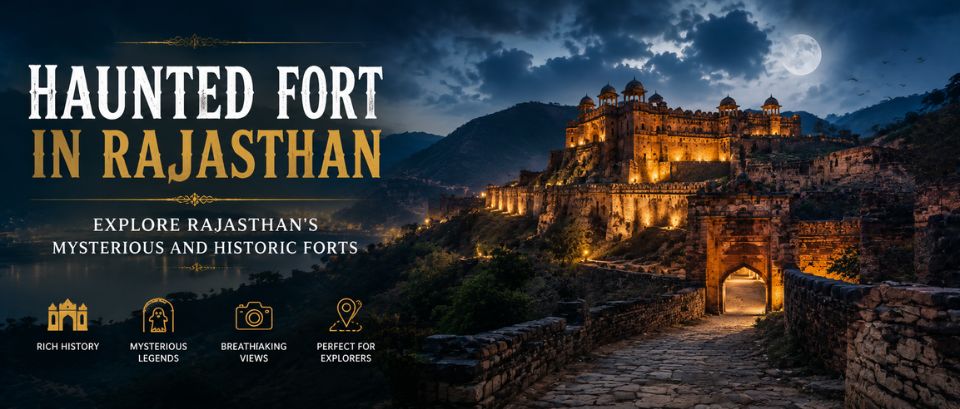
Rajasthan is a land where history is etched into every stone, woven into every folktale, and carried in the imagination of every traveler who visits. Its forts are far more than ancient monuments—they are living chronicles of courage, sacrifice, and royal grandeur. Yet not every story is one of triumph. Some are marked by tragedy, while others have given rise to chilling legends that continue to captivate visitors. If you’re searching for a haunted fort in Rajasthan, you’ll discover places where history and mystery come together, creating an atmosphere that is as fascinating as it is unforgettable.
This guide covers the most significant forts in the state, the ones that every traveller should experience at least once. Some are celebrated for their architecture. Some carry royal legacies that shaped the history of India. And one, above all others, has earned a reputation that no other monument in the country can claim.
Whether you are a history enthusiast, an architecture lover, or someone who is just genuinely curious about the supernatural side of Rajasthan, this guide will give you everything you need before you visit.
Bhangarh Fort: The Most Famous Haunted Fort in Rajasthan
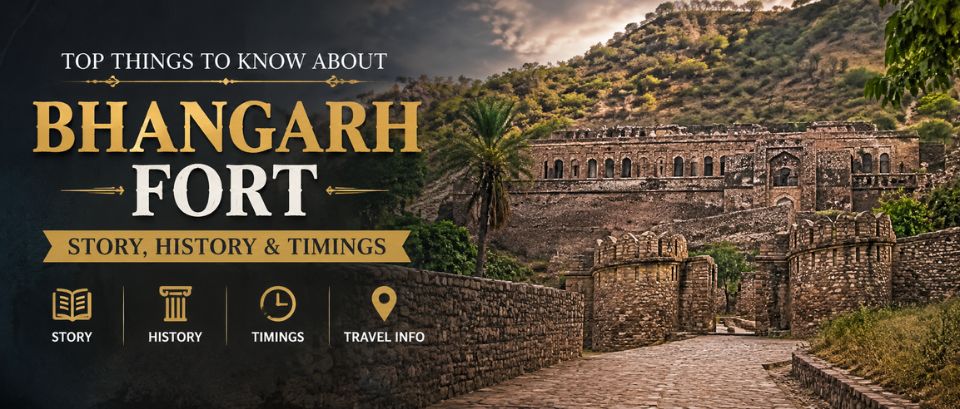
If there is one place in Rajasthan that sits at the intersection of history and mystery, it is Bhangarh. Located in the Alwar district, roughly 83 kilometres from Jaipur, Bhangarh Fort was built in the 17th century by Raja Madho Singh, the younger brother of the great Mughal general Man Singh of Amber. At its peak, the town within the fortification housed over 9,000 residents and was a thriving settlement with markets, temples, and grand havelis.
Today, it is abandoned. It is widely considered the most well-known haunted fort in Rajasthan, as well as one of the most haunted places in the entire country. The Archaeological Survey of India has posted notices at the entrance explicitly prohibiting entry before sunrise and after sunset.
The legends attached to Bhangarh are centuries old. The more popular of the two stories involves a tantric magician who fell in love with the beautiful Princess Ratnavati. When his attempt to use a love potion on her failed, he was killed, but not before cursing the entire kingdom. The fort was later attacked and the town destroyed. According to local belief, the souls of those who perished have never left.
The second legend involves a sadhu named Baba Balau Nath, who gave permission to build the fort on his meditating ground on one condition: the shadow of the palace should never fall on his dwelling. When a later ruler raised the palace height and the shadow fell, destruction followed.
Contrary to its eerie reputation, Bhangarh is a tranquil and atmospheric destination during the day. Its sprawling ruins include ancient temples, havelis, and marketplaces, while monkeys wander freely among the weathered archways, adding to the site’s timeless charm. The surrounding Aravalli hills create a naturally dramatic backdrop. Many visitors who come expecting horror leave feeling that the fort is more emotional, historical, and quietly haunting than actively frightening.
Entry to Bhangarh is open between 6 AM and 6 PM. Entry fees are Rs. 25 for Indians and Rs. 200 for foreign nationals.
Nahargarh Fort: A Scenic Fort with a Darker Reputation
Perched on the edge of the Aravalli Hills overlooking Jaipur, Nahargarh Fort was built in 1734 by Sawai Jai Singh II. Its name means “abode of tigers,” though a second explanation links it to the spirit of Nahar Singh Bhomia, a Rajput prince whose ghost was said to trouble the fort’s construction until a shrine was built in his honour within the walls.
The fort itself is one of the most photographed spots in Jaipur, offering sweeping panoramic views of the Pink City below and the surrounding plains. Madhavendra Bhawan, a palace built inside the fort for the king’s nine queens, is an architectural highlight with identical yet distinctly individual suites arranged around a central corridor, each one decorated with murals and intricate mirror work.
The fort does carry stories of unexplained incidents, particularly during renovation work, and locals often speak about its atmosphere at dusk with a certain caution. Whether you visit for the sunset views or because of the folklore, Nahargarh is consistently one of the most memorable stops in Jaipur.
The Famous Forts in Rajasthan You Cannot Miss
Rajasthan has over 100 forts and fort-palaces, but a handful of them stand out as essential visits for any serious traveller. These are the structures that shaped kingdoms, withstood invasions, and defined what the Rajput legacy means in stone and mortar. From local sightseeing to long-distance tours, our Car Rental Service in Jaipur provides flexible travel options with clean vehicles and professional chauffeurs for every type of traveler.
Amber Fort, Jaipur
Amber Fort, also written as Amer Fort, is one of the most visited heritage sites in all of India. Built in the 16th century by Raja Man Singh I, it sits on the Aravalli Range overlooking the tranquil Maota Lake below. The fort is a masterclass in the blend of Rajput and Mughal architectural traditions. Red sandstone and white marble have been used together throughout the complex, and the detailing in carved surfaces, doorways, and latticed screens is extraordinary.
The Sheesh Mahal, or Hall of Mirrors, is the most celebrated chamber inside the fort. Thousands of tiny mirror pieces cover every surface, and a single lamp reflected endlessly creates the effect of a star-filled sky. It remains one of the most impressive rooms in any fort or palace in India.
Amber Fort is a UNESCO World Heritage Site and receives millions of visitors annually. The light and sound show held in the evenings is a popular way to experience the fort after dark.
Entry timings are 8 AM to 6 PM. Entry fee is Rs. 100 for Indian adults and Rs. 500 for foreign nationals.
Mehrangarh Fort, Jodhpur
Standing on a 400-foot-high rocky outcrop above the Blue City of Jodhpur, Mehrangarh is one of the largest and most imposing forts in India. Its walls rise sheer from the rock below and the scale of the structure is visible from almost anywhere in Jodhpur.
Construction began in 1459 under Rao Jodha, the founder of Jodhpur, and successive rulers expanded and modified it over the centuries. The fort houses seven gates, the most famous of which is Jayapol, built to celebrate victory over the armies of Jaipur and Bikaner. Inside, several palaces including Moti Mahal, Phool Mahal, and Sheesh Mahal display extraordinary craftsmanship in their carved sandstone screens, painted ceilings, and ornate interiors.
Mehrangarh also carries its own stories of sacrifice and curse. Around 15 handprint murals near one of the gates are said to be impressions left by queens of Maharaja Man Singh who committed sati in 1843. Local folklore includes a curse by a holy man named Cheeria Nathji, who declared that the land would always suffer water scarcity.
The fort museum houses one of the finest collections of royal artefacts in Rajasthan, including royal palanquins, paintings, arms and armour, and elephant accessories. Entry timings are 9 AM to 5 PM.
Jaisalmer Fort
Jaisalmer Fort, known locally as Sonar Quila or the Golden Fort, is unlike any other fort in Rajasthan or India. Built in 1156 AD by Bhati Rajput ruler Rao Jaisal on the Trikuta hill in the Thar Desert, it is a UNESCO World Heritage Site and is still a living fort. Approximately one-quarter of the city’s population resides within the fort’s walls. The fort remains a vibrant, living community, with hotels, restaurants, shops, Jain temples, and Hindu shrines all operating within its historic boundaries.
The fort is made of yellow sandstone that glows with a deep golden colour at sunrise and sunset, which explains Jaisalmer’s nickname as the Golden City. Walking through its narrow lanes at dusk, with the stone lit in amber and the distant desert visible from the ramparts, is one of the most memorable experiences Rajasthan has to offer.
Chittorgarh Fort
Chittorgarh Fort is the largest fort in India by area, covering approximately 700 acres on a plateau above the town of Chittorgarh. It is a UNESCO World Heritage Site and carries one of the most dramatic histories of any fort in the country.
The fort witnessed three major jauhars, a practice where Rajput women chose self-immolation over capture by enemies. The most famous of these involved Rani Padmini and the siege by Alauddin Khilji in 1303. The ruins of Padmini’s Palace, the Rana Kumbha Palace, the Victory Tower, and the Tower of Fame all remain within the fort complex.
Visitors have reported feeling a weight in the air inside certain parts of the fort, particularly around Rana Kumbha Palace, and it is sometimes included in lists of Rajasthan’s most eerie sites. Whether or not one believes in such things, the sheer volume of tragedy and sacrifice this fort witnessed over centuries gives it an atmosphere unlike anywhere else.
Kumbhalgarh Fort
Kumbhalgarh Fort, built by Maharana Kumbha in the 15th century, is famous for having the second-longest wall in the world after the Great Wall of China. The wall stretches for approximately 36 kilometres around the fort and the countryside it protects, enclosing 360 temples and numerous palaces and residences.
Located about 84 kilometres from Udaipur in the Rajsamand district, it sits deep in the Aravalli Hills surrounded by thick forests. The fort is the birthplace of Maharana Pratap, the legendary Rajput king who resisted Mughal rule for decades. A night-time light and sound show at Kumbhalgarh is one of the best of its kind in Rajasthan.
Junagarh Fort, Bikaner
Unlike most major forts in Rajasthan, Junagarh Fort was built on flat ground rather than on a hill. Built between 1589 and 1594 under Raja Rai Singh, a commander in the court of Emperor Akbar, it is notable for never having been captured by any invader despite numerous attempts.
The fort is a blend of Rajput, Mughal, Gujarati, and later British architectural influences. Inside, palaces such as Anup Mahal, Chandra Mahal, and Phool Mahal are decorated with intricate carvings, glass mosaics, gold leaf work, and lacquer paintings that represent some of the finest decorative arts in Rajasthan. Entry timings are 10 AM to 4:30 PM.
How to Travel Between Rajasthan’s Forts
Rajasthan’s forts are spread across the state, from Jaipur in the east to Jaisalmer in the far west and Chittorgarh in the south. The distances between major forts can be significant, and the most comfortable and practical way to explore them is by booking a private cab or Tempo Traveller for group travel.
A well-planned Rajasthan fort circuit typically starts in Jaipur, covering Amber Fort, Nahargarh, and Jaigarh, before moving to Jodhpur for Mehrangarh, then westward to Jaisalmer, and back through Chittorgarh and Kumbhalgarh to complete the loop. Rajasthan Taxi Rental provides reliable cab services across all major fort destinations with experienced drivers who know the routes and can help you make the most of your time between stops. Book our trusted Taxi Service in Jaipur for city tours, business travel, railway station transfers, or weekend getaways, and enjoy a comfortable travel experience every time.
The best time to visit is between October and March when the weather is cool enough to spend several hours exploring outdoor heritage sites comfortably.
Frequently Asked Questions
Q1. Which is the most haunted fort in Rajasthan?
Bhangarh Fort in the Alwar district is considered the most famous haunted fort in Rajasthan and is widely referred to as one of the most haunted places in India. The Archaeological Survey of India prohibits entry before sunrise and after sunset. The fort is associated with two major legends involving a cursed sadhu and a tantric magician, and paranormal experiences have been reported by visitors over the years.
Q2. Which are the most famous forts in Rajasthan that every tourist must visit?
The most famous forts in Rajasthan that every visitor should include in their itinerary are Amber Fort in Jaipur, Mehrangarh Fort in Jodhpur, Jaisalmer Fort, Chittorgarh Fort, Kumbhalgarh Fort near Udaipur, and Junagarh Fort in Bikaner. Six of Rajasthan’s forts are also listed as UNESCO World Heritage Sites, including Amber, Chittorgarh, Kumbhalgarh, Ranthambore, Gagron, and Jaisalmer forts.
Q3. Can visitors enter Bhangarh Fort at night?
No. Entry to Bhangarh Fort is strictly prohibited after sunset and before sunrise. The Archaeological Survey of India enforces this restriction, and notices posted at the fort’s entrance make this clear. During daylight hours, the fort is open to all visitors between 6 AM and 6 PM, and it is a popular tourist destination.
Q4. How many days are needed to cover the major forts of Rajasthan?
To cover the key forts of Rajasthan including Jaipur, Jodhpur, Jaisalmer, Chittorgarh, and Kumbhalgarh, you should plan for at least 10 to 12 days. A shorter trip of 5 to 7 days can cover the Golden Triangle circuit of Jaipur, Jodhpur, and Jaisalmer with their respective forts comfortably.
Q5. What is the best way to travel between forts in Rajasthan?
The best way to travel between Rajasthan’s forts is by private cab or Tempo Traveller for group travel. Public transport options exist but are time-consuming and inconvenient when carrying luggage between multiple cities. Hiring a cab through a reliable service like Rajasthan Taxi Rental gives you the flexibility to start early in the morning, make stops along the way, and cover more ground each day without depending on bus or train schedules.