- Connect Us:
- +91-9414816181
- info@rajasthantaxirental.com

Jaipur to Mount Abu Distance, Route, Time & Travel Tips

Jaipur to Vaishno Devi Distance: Everything You Need to Know
June 10, 2026
Jaipur Temples: Famous Religious Places and Must Visit Temples
June 19, 2026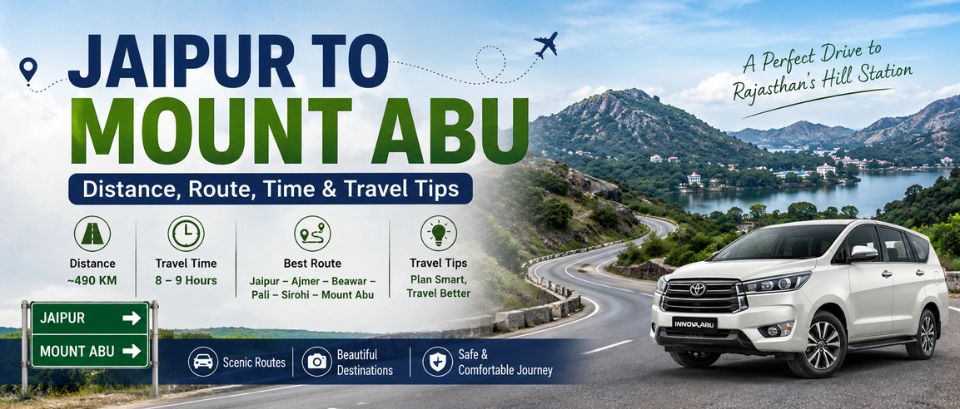
Rajasthan is largely a state of deserts and dry plains, which is exactly why Mount Abu stands out. It is the only hill station in the entire state, tucked into the southern tip of the Aravalli Range right on the border with Gujarat. For someone living in Jaipur, this means a genuine change of climate and landscape is only a long drive away. This guide goes deep into the actual route, the realistic driving time, what each transport mode involves in practice, and the details that most short travel guides skip, like where the road actually gets difficult and what it costs to drive there.
Jaipur to Mount Abu Distance: What the Numbers Actually Mean
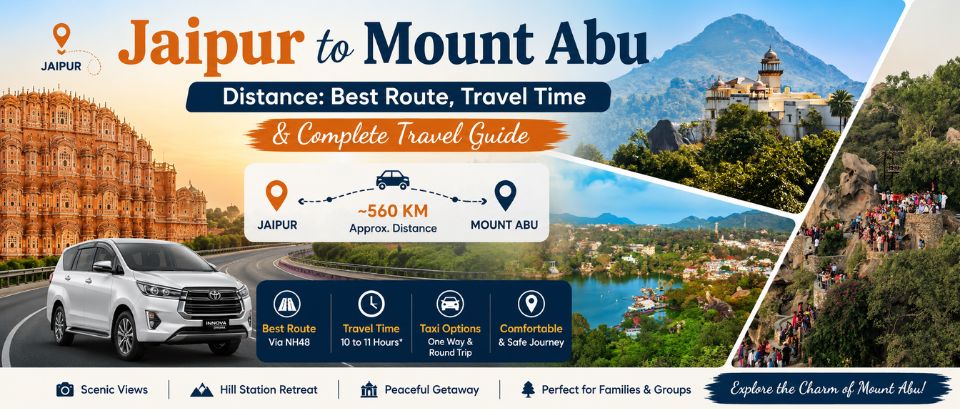
The Jaipur to Mount Abu distance by road sits between 490 and 510 kilometers, depending on which combination of highways you take and your exact starting point inside Jaipur. This is not a small variance to ignore. A traveler starting from Jaipur’s southern outskirts near Tonk Road will cover a noticeably shorter distance than someone starting from the northern parts of the city near Amer.
On the way back, the Mount Abu to Jaipur distance is essentially identical, since the same highway network is used in reverse. There is no shorter “return route” that locals use, despite what some forum posts suggest. What does change on the return trip is traffic density, particularly around Ajmer and Beawar in the late afternoon, which can add 30 to 45 minutes compared to a morning departure from Mount Abu.
In terms of actual time on the road, a private car covers this distance in 8 to 10 hours of pure driving. Add fuel stops, a meal break, and the slower hill section near the end, and the realistic door-to-door time for most travelers lands between 9.5 and 11 hours.
The Route in Real Detail: Jaipur to Ajmer to Beawar to Pali to Sirohi to Abu Road
This is the route almost every taxi driver, tour operator, and seasoned traveler on this corridor uses, and for good reason. It runs largely along NH48 with a transition onto NH27 closer to the hills.
| Route Segment | Distance | Approx. Driving Time |
|---|---|---|
| Jaipur to Ajmer | 135 km | 2.5 to 3 hours |
| Ajmer to Beawar | 50 km | 1 hour |
| Beawar to Pali | 100 km | 1.5 to 2 hours |
| Pali to Sirohi to Abu Road | 150 to 160 km | 3 hours |
| Abu Road to Mount Abu | 28 km | 45 minutes to 1 hour |
| Total | 490 to 510 km | 8 to 10 hours |
Jaipur to Ajmer covers roughly 135 km and takes about 2.5 to 3 hours. This stretch is flat, fast, and well-lit with service lanes near Kishangarh, where the marble industry creates noticeable truck traffic, something worth being aware of if you are driving yourself rather than hiring a chauffeur.
Ajmer to Beawar adds another 50 km, roughly an hour of driving. The road through this section narrows slightly compared to the Jaipur-Ajmer expressway stretch, but remains a smooth two-lane highway.
Beawar to Pali covers approximately 100 km and takes 1.5 to 2 hours. This is one of the quieter stretches, passing through smaller towns and agricultural land, with fewer dhabas compared to the earlier sections, so this is a sensible point to plan your main meal stop before you leave Beawar rather than after.
Pali to Sirohi to Abu Road covers the final 150 to 160 km and is where the character of the drive shifts noticeably. The terrain starts rising, the air gets visibly cooler even before you reach the base, and the road begins curving through the foothills of the Aravallis.
Abu Road to Mount Abu is only 28 km, but this is the section that defines the entire trip. It is a continuous climb through roughly 28 hairpin turns cut into the hillside, gaining elevation from around 300 meters at Abu Road to over 1,200 meters at Mount Abu town. Locals and experienced drivers treat this stretch with real respect. It typically takes 45 minutes to an hour even though the distance is short, because speeds here rarely exceed 30 to 40 km/h on the sharper bends.
What the Drive Actually Costs
Most travel blogs mention distance and time but skip the practical cost breakdown, which matters if you are planning a self-driven trip or comparing against a taxi quote.
| Cost Head (One Way) | Approx. Amount |
|---|---|
| Fuel (Sedan) | Rs. 3,500 to 4,000 |
| Toll Charges (NH48 and NH27) | Rs. 700 to 1,000 |
| Food for a Group of 4 | Rs. 800 to 1,500 |
| Total Self-Drive Cost (Sedan) | Rs. 5,000 to 6,500 |
| Taxi Booking – Sedan | Rs. 5,000 to 5,500 |
| Taxi Booking – SUV (Innova type) | Rs. 6,500 to 7,000 |
| Tempo Traveller / Urbania | Rs. 9,500 to 10,000 |
For a private car covering the roughly 500 km one-way trip, fuel costs typically run between 3,500 and 4,000 rupees for a sedan, depending on current diesel or petrol prices. Toll charges across the NH48 and NH27 stretches generally add another 700 to 1,000 rupees one way, spread across multiple toll plazas along the route. If you are stopping for meals along the way, budget another 800 to 1,500 rupees for a group of four, which brings the realistic one-way cost for a self-driven sedan to somewhere between 5,000 and 6,500 rupees, not counting accommodation in Mount Abu.
Hired taxi rates vary by vehicle type, as shown in the table above. Toll and state tax are usually charged separately on top of the base taxi fare.
Jaipur to Mount Abu by Train
Taking jaipur to mount abu by train means accepting one unavoidable fact upfront. Mount Abu has no railway station of its own. The nearest station is Abu Road, sitting at the base of the hill, roughly 28 km from the town itself.
Trains like the Jaipur-Ahmedabad Express and the Aravali Express connect Jaipur to Abu Road, with the journey typically taking 5 to 6 hours depending on the specific train and number of stops. Fares are reasonable, generally ranging from a few hundred rupees in sleeper class to higher amounts for AC chair car or AC sleeper.
Once you land at Abu Road station, you are not at your destination yet. You will need to either book a taxi or catch a local bus for the remaining climb, which adds 45 minutes to an hour and another few hundred rupees to your total journey cost. This makes train travel a reasonable choice for solo travelers or couples who do not mind the transfer, but less convenient for families carrying luggage who would rather avoid switching vehicles midway.
Jaipur to Mount Abu Bus
For travelers on a tighter budget, jaipur to mount abu bus services run through both RSRTC government buses and several private operators. Direct buses typically take 10 to 12 hours, noticeably longer than driving privately, largely because buses stop at multiple towns along the way to pick up and drop passengers.
Many private operators schedule their buses to depart Jaipur in the evening, somewhere around 8 or 9 PM, so passengers arrive in Mount Abu early the next morning and can start sightseeing without losing a day to travel. Sleeper and Volvo AC coaches are available on this route for those who want a more comfortable overnight option compared to a regular seater bus.
The trade-off with buses is flexibility. You cannot easily ask the driver to stop at Pushkar for twenty minutes or pull over at a scenic point near Sirohi. If your goal is purely to reach Mount Abu as cheaply as possible without caring about the journey itself, a bus works fine. If the road trip is part of the experience you want, it is not the right choice.
Comparing All Travel Modes at a Glance
| Mode | Total Time | Approx. Cost (One Way) | Best Suited For |
|---|---|---|---|
| Private Car / Taxi | 8 to 10 hours | Rs. 5,000 to 7,000 | Families, flexible stops |
| Train + Taxi from Abu Road | 6 to 7 hours total | Rs. 500 to 1,500 | Solo travelers, couples |
| Direct Bus | 10 to 12 hours | Rs. 600 to 1,800 | Budget travelers |
| Urbania / Tempo Traveller | 9 to 11 hours | Rs. 9,500 to 10,000+ | Groups of 8 to 13 |
Jaipur to Mount Abu Taxi: Why Most Families Choose This
For families, couples, and small groups, booking a Jaipur to Mount Abu Taxi remains the most practical balance between comfort, cost, and flexibility. Unlike a bus, you control your own departure time. Unlike a train, you do not need to switch vehicles partway through.
Experienced drivers on this route consistently recommend starting between 5 and 6 AM. This timing matters for two specific reasons beyond just avoiding traffic. First, it means you complete the winding Abu Road to Mount Abu climb during daylight, which is genuinely safer given the hairpin turns and occasional fog in winter mornings. Second, an early start means you arrive at Mount Abu by mid-afternoon with enough daylight left to check into your hotel, rest briefly, and still catch the evening at Nakki Lake or Sunset Point on the same day rather than losing the entire first evening to travel fatigue.
A taxi also lets you build in the Ajmer and Pushkar diversion, which adds only 30 to 40 minutes to the total trip but gives you a meaningful stop at the Ajmer Sharif Dargah or a quick visit to Pushkar Lake if you have not seen either before.
When a Taxi Is Not Enough: Bigger Groups Need Bigger Vehicles
A standard sedan or even an SUV works fine for two to four passengers, but pilgrim groups heading to the Dilwara Temples, extended families on a reunion trip, or college friend groups often run into a different problem. Splitting into two or three separate cabs for a 500 km journey creates its own headaches, coordinating fuel stops, making sure everyone reaches the hotel around the same time, and managing the cost of multiple vehicles instead of one.
This is where a Force Urbania makes a genuine difference. Jaipur to Mount Innova Crysta Rental options work well for mid-sized groups of five to six people who want SUV-level comfort and a bit more luggage room than a sedan, particularly useful given that the hill roads near Abu Road handle a slightly heavier vehicle with more stability than a low sedan would on the sharper bends.
For larger groups of eight to thirteen passengers, the Urbania is the more sensible choice. Everyone travels in one vehicle, the air conditioning handles the long flat stretches through Ajmer and Beawar comfortably, and the seating is built for longer journeys with proper legroom rather than the cramped feel of a packed sedan. Booking through Luxury Urbania Rental Jaipur also means the driver assigned to your trip has handled this specific route before and understands where the road tightens near Sirohi and how to approach the Abu Road climb without rushing it.
Best Time of Year for This Drive
| Season | Months | What to Expect |
|---|---|---|
| Winter | October to March | Cool, pleasant, best for sightseeing; occasional morning fog near Abu Road |
| Summer | April to June | Hot on plains, Mount Abu stays noticeably cooler |
| Monsoon | July to September | Lush, scenic, but the hill climb can get slippery |
October through March is the clear favorite for this route, and there is a practical driving reason behind it beyond just comfortable weather. The hairpin section near Abu Road can develop fog in early winter mornings, so a slightly later start, closer to 7 AM during December and January, is sometimes safer than the typical 5 AM recommendation.
April through June brings intense heat to the plains around Jaipur, Ajmer, and Beawar, though Mount Abu itself stays noticeably cooler due to elevation, which is exactly why this period sees a spike in Rajasthani families escaping the heat for a few days.
Monsoon season from July to September turns the entire Aravalli stretch green and genuinely beautiful, but the winding climb near Abu Road can get slippery during heavy rain. Drivers who know this route well simply slow down further during this season rather than avoiding it altogether, since the scenery during monsoon is considered by many regular travelers to be the best time to see this particular stretch of road.
What to See Once You Arrive
Nakki Lake sits right in the center of town and remains the easiest, most relaxed activity after a long drive, ideal for an evening boat ride once you have checked into your hotel. The Dilwara Jain Temples, located a short distance from the main town, are closed between 12 PM and 2 PM daily and do not permit photography inside, a detail that catches first-time visitors off guard, so plan your visit either in the morning or after 2 PM. Guru Shikhar, the highest point in the entire Aravalli Range at 1,722 meters, is about 15 km from town and offers the most expansive views in the area. Achalgarh Fort, a 14th century structure with an attached Shiva temple, makes for a quieter alternative if the main town feels crowded during peak season. Trevor’s Tank, roughly 5 km outside town, is a lesser-known reservoir spot favored by those interested in spotting wildlife rather than the more touristy lake views.
Frequently Asked Questions
Q1. What is the exact Jaipur to Mount Abu distance by road, and does it vary by route?
The Jaipur to Mount Abu distance ranges from 490 to 510 kilometers, depending on which highway combination you use and your exact starting point in Jaipur. The most commonly used route via Ajmer, Beawar, Pali, and Sirohi covers approximately 500 km and takes 8 to 10 hours of driving.
Q2. Is the Mount Abu to Jaipur distance the same on the way back, or is there a shorter return route?
The Mount Abu to Jaipur distance is essentially the same as the outbound distance, since the route works identically in both directions. There is no shorter alternate path. The only real difference on the return leg is traffic density near Ajmer and Beawar during late afternoon hours, which can add some extra time compared to an early morning departure.
Q3. Is traveling from Jaipur to Mount Abu by train a good option if I do not want to drive?
Yes, but with one important caveat. Jaipur to Mount Abu by train gets you to Abu Road station in about 5 to 6 hours, but Mount Abu itself has no railway station. You will need a taxi or local bus for the final 28 km uphill, adding around 45 minutes and some extra cost to your total journey.
Q4. How long does a direct Jaipur to Mount Abu bus actually take compared to driving?
A direct Jaipur to Mount Abu bus takes around 10 to 12 hours, noticeably longer than the 8 to 10 hours a private car needs, mainly because buses stop at multiple towns to pick up and drop passengers along the way. Most operators schedule evening departures so passengers arrive early the next morning.
Q5. What kind of vehicle should I book for a group heading to Mount Abu from Jaipur?
For two to four passengers, a sedan works fine. For five to six people, a Jaipur to Mount Innova Crysta Rental offers the right balance of comfort and luggage space for the hill climb. For larger groups of eight to thirteen people, a Force Urbania booked through Luxury Urbania Rental Jaipur keeps everyone together in one vehicle with proper legroom and a driver familiar with the Sirohi and Abu Road climb.